
Development of Cinchonine Emulgel as a Topical Antibacterial using Response Surface Methodology

Downloads
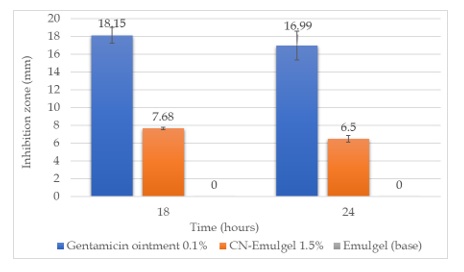
Cinchonine has potential as a topical antibiotic with a mechanism of action that inhibits bacterial cell wall formation. Cinchonine is insoluble in water, resulting in poor penetration. The aim of the research was to develop a cinchonine emulgel formula using the Response Surface Method (D-optimal) as an antibacterial with parameters spreadability, adhesiveness, pH, and viscosity. The optimum cinchonine emulgel was determined based on the desirability value (range 0-1). The release test of cinchonine emulgel was carried out using a 12-14 kD cut-off dialysis bag. Cinchonine emulgel was tested for antibacterial activity against Pseudomonas aeruginosa and Staphylococcus aureus by the diffusion method with a positive control and a negative control. The inhibition zone parameters were carried out with observation intervals of 18 and 24 hours. Stability test of the optimum formula was carried out by cycling test and accelerated method with test parameters including spreadability, adhesiveness, and pH. The optimum composition of cinchonine emulgel consisted of cinchonine 1.5; HPMC 2; glycerin 1; tween 80 4.99; propylene glycol 1.14; oleic acid 14.84; and deionized water up to 100% with a desirability value: 0.504, spreadability: 3.92±0.38cm; adhesiveness: 2.17±0.29 second, pH: 4.72±0.11; and viscosity: 12050±900.39cP (p<0.05). The release of cinchonine emulgel was 19.25% controlled. Observation of inhibition zone at 18 and 24 hours respectively for cinchonine emulgel preparation against Pseudomonas aeruginosa was 7.68±0.14 and 6.50±0.37mm, Staphylococcus aureus was 10.47±0.37 and 10.36±0.69mm compared to control (gentamicin ointment: 18.15±0.90, and 16.99±1.61mm; blank control: 0.00±0.00, and 0.00±0.00mm). Cinchonine emulgel had good stability during short-term storage.
Downloads
Ramić A, Skočibušić M, Odžak R, Čipak GA, Milković L, Mikelić A, et al. Antimicrobial Activity of Quasi-Enantiomeric Cinchona Alkaloid Derivatives and Prediction Model Developed by Machine Learning. Antibiotics. 2021 May 31; 10(6):659. doi:10.3390/antibiotics10060659
Hariyanti H, Syarifah A, Genatrika E, Pangestu M, Kalista FD, Karisma FD, et al. Penggunaan Simplex Lattice Design (SLD) dalam Optimasi HPMC dan Propilen Glikol Formula Gel Cinchonine Sebagai antibakteri Cutibacterium acnes (C. Acne). Healthy-Mu Journal. 2025 Jun 30; 9(1):27–34. doi:10.35747/hmj.v9i1.1302
Octaviani M, Jannah M, Wulandari R, Utami R, Fadhli H. Isolation and Antibacterial Activity Isolate of The Endophytic Fungi of Shallot Tubers (Allium cepa L.) Against Pathogen Bacteria. Jurnal Kefarmasian Indonesia. 2024; 14(2).
Sami FJ, Nur S. Cytotoxic Effect, Antibacterial Activity, and in Silico Evaluation of Berberine Compound from Methanolic Extract of Arcangelisia flava Merr Stems. Jurnal Kefarmasian Indonesia. 2024; 14(1).
Hariyanti H, Mauludin R, Sumirtapura YC, Kurniati NF. A Review: Pharmacological Activities of Quinoline Alkaloid of Cinchona sp. Biointerface Research in Applied Chemistry. 2022 Sep 11; 13(4): 319. doi:10.33263/BRIAC134.319
Hariyanti H, Mauludin R, Sumirtapura YC, Kurniati NF. Activity and Safety of Cinchonine Nanostructured Lipid Carriers as a Hair Growth Stimulant in Mice Model of Androgenetic Alopecia. Sains Malaysiana. 2023 Jun 30; 52(6): 1671–83. doi:10.17576/jsm-2023-5206-05
Hidayat IR, Zuhrotun A, Sopyan I. Artikel Review : Design-Expert Software sebagai Alat Optimasi Formulasi Sediaan Farmasi. Majalah Farmasetika. 2021; 6(1): 99–120. doi:10.24198/mfarmasetika.v6i1.27842
Hariyanti H, Kurniati NF, Sumi̇rtapura YC, Mauludin R. Development and validation of an analytical method for the determination of nanostructured lipid carrier’s cinchonine used direct method modified by liquid-liquid extraction using high-performance liquid chromatography. Journal of Research in Pharmacy. 2023; 27(2): 913–923. doi:10.29228/jrp.371
Hariyanti H, Kurniati NF, Sumirtapura YC, Mauludin R. Cinchonine‐loaded nanostructured lipid carriers for targeted delivery to hair follicles. Journal of Pharmacy & Pharmacognosy Research. 2025 Nov 1; 13(6): 2004–19. doi:10.56499/jppres25.2354_13.6.2004
Permanasari H, Ikhsanudin A, Mulyaningsih S. Formulasi dan Aktivitas Antibakteri Sediaan Emulgel Ekstrak Etanol Rimpang Temu Kunci (Boesenbergia Pandurata) terhadap Staphylococcus Aureus. Prosiding Seminar Nasional Pusat Informasi dan Kajian Obat. 2022; 1: 46–51.
Priani SE, Syafnir L, Mulkiya K, Fitrianingsih SP, Radina F. Pengembangan Sediaan Emulgel Ekstrak Etanol Teh Putih dan Minyak Biji Delima dengan Aktivitas Antioksidan dan Fotoprotektif. Jurnal Mandala Pharmacon Indonesia. 2024 Jun 23; 10(1): 43–53. doi:10.35311/jmpi.v10i1.458
Yogaswara PH, Azzahra F. Uji Aktivitas Antibakteri Ekstrak Etanol Daun Alpukat (Persea americana Mill.) terhadap Bakteri Pseudomonas aeruginosa. Jurnal Kefarmasian Akfarindo. 2021; 7–14. doi:10.37089/jofar.vi0.102
Shintyawati D, Widiastuti R, Sulistyowati R. Formulasi Dan Uji Stabilitas Fisik Emulgel Ekstrak Daun Binahong (Anredera cordifolia) Sebagai Tabir Surya. Forte Journal. 2024 Jan 31; 4(1): 01–12. doi:10.51771/fj.v4i1.626
European Medicines Agency. ICH Q1 Guideline on stability testing of drug substances and drug products Step 2b. Vol. 31. 2025; 31(April).
BPOM RI. Peraturan BPOM No 10 Tahun 2022 Pedoman Uji Toksisitas Praklinik Secara In Vivo. BPOM RI. 2022; (490): 1–16. PubMed PMID: 25246403.
Al-Jarsha HYM, Ghareeb MM. Validation of UV-visible spectrophotometric method for niclosamide in different media. Tropical Journal of Pharmaceutical Research. 2024 Jun 25; 23(5): 871–80. doi:10.4314/tjpr.v23i5.9
Dushna O, Dubenska L, Marton M, Hatala M, Vojs M. Sensitive and selective voltammetric method for determination of quinoline alkaloid, quinine in soft drinks and urine by applying a boron-doped diamond electrode. Microchemical Journal. 2023 Aug; 191: 108839. doi:10.1016/j.microc.2023.108839
Ramadhanti A, Nurjanah S, Widyasanti A, Ainina N. Pemodelan kondisi hidrodistilasi minyak atsiri jahe merah (Zingiber officinale var. Roscoe) dengan menggunakan Response Surface Methodology. AGROINTEK: Jurnal Teknologi Industri Pertanian. 2024 May 9; 18(2): 429–39. doi:10.21107/agrointek.v18i2.18904
Gómez-Farto A, Jiménez-Escobar AL, Pérez-González N, Castán H, Clares B, Arias-Santiago S, et al. Development of an Emulgel for the Effective Treatment of Atopic Dermatitis: Biocompatibility and Clinical Investigation. Gels. 2024 May 27; 10(6): 370. doi:10.3390/gels10060370
Badruddoza AZM, Zahid MI, Walsh T, Shah J, Gates D, Yeoh T, et al. Topical drug delivery by Sepineo P600 emulgel: Relationship between rheology, physical stability, and formulation performance. International Journal of Pharmaceutics. 2024 Jun; 658: 124210. doi:10.1016/j.ijpharm.2024.124210
Setiyawan SJ, Astuti IY, Hariyanti H. Optimization of Phosphatidylcholine and Tween 80 Composition in the Formulation of Icariin Transfersome as a Transdermal Delivery System using Design-Expert. Jurnal Kefarmasian Indonesia. 2025; 15(2).
Martsiningsih A, Suyana S, Noviani A, Rahmawati U, Sujono S, Astuti FD. Pengaruh Waktu Inkubasi Terhadap Diameter Zona Hambat Antibiotik Pada Uji Sensitivitas Bakteri Klebsiella Pneumonia. Meditory : The Journal of Medical Laboratory. 2023 Jun 4; 11(1): 1–8. doi:10.33992/meditory.v11i1.2361
Sampulawa S, Nirmala W. Potensi Antibakteri Ekstrak Alga Hijau Halimeda makroloba Decaisne dari Perairan Desa Hutumuri Kota Ambon. Jurnal Sain Veteriner. 2021 Sep 8; 39(2): 138. doi:10.22146/jsv.59980
Anggita D, Nurisyah S, Wiriansya EP. Mekanisme Kerja Antibiotik: Review Article. UMI Medical Journal. 2022 Jun 30; 7(1): 46–58. doi:10.33096/umj.v7i1.149
Vlad RA, Pintea A, Pintea C, Rédai EM, Antonoaea P, Bîrsan M, et al. Hydroxypropyl Methylcellulose—A Key Excipient in Pharmaceutical Drug Delivery Systems. Pharmaceutics. 2025 Jun 16; 17(6): 784. doi:10.3390/pharmaceutics17060784
Zhou Z, Li YL, Zhao F, Xin R, Huang XH, Zhang YY, et al. Unraveling the Thermal Oxidation Products and Peroxidation Mechanisms of Different Chemical Structures of Lipids: An Example of Molecules Containing Oleic Acid. Journal of Agricultural and Food Chemistry. 2022 Dec 28; 70(51): 16410-16423. doi:10.1021/acs.jafc.2c06221.
Copyright (c) 2026 Jurnal Kefarmasian Indonesia

This work is licensed under a Creative Commons Attribution-NonCommercial-ShareAlike 4.0 International License.


