
Syzygium polyanthum Leaf Ethanol Extract Accelerates Incision Wound Healing in Streptozotocin-Induced Diabetic Rats and Modulates NF-κB, iNOS and MMP-1

Downloads
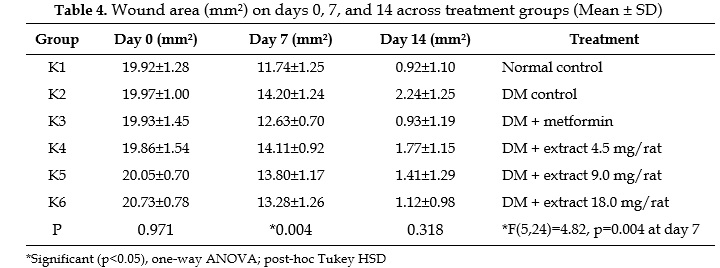
Diabetes mellitus (DM) significantly impairs wound healing through disruption of the inflammatory response and tissue metabolism. This study aimed to analyze the effect of ethanol extract of bay leaf (Syzygium polyanthum (Wight) Walp.) on NF-κB, iNOS, MMP-1, and wound healing in streptozotocin (STZ)-induced diabetic rats with incision wounds. A true experimental laboratory study with a post-test randomized controlled group design was conducted. Thirty male Wistar rats (n=5/group) were divided into six groups: normal control, DM control (STZ 40 mg/kgBW), DM with metformin (9.0 mg/rat/day), and DM with S. polyanthum extract at doses of 4.5, 9.0, and 18.0 mg/rat/day (equivalent to 250, 500, and 1000 mg/day human doses). Diabetes was induced by intraperitoneal STZ injection; wound healing was assessed on days 0, 7, and 14. Serum NF-κB, iNOS, and MMP-1 were measured by ELISA on day 14. Phytochemical screening confirmed flavonoids, alkaloids, saponins, tannins, and phenols, with total flavonoid content of 5.18 ± 0.16 mg QE/g extract and total phenolic content of 67.54 ± 0.64 mg GAE/g extract. Extraction yield was 11.35%. No significant differences were observed in serum NF-κB (p=0.103), iNOS (p=0.263), or MMP-1 (p=0.108) on day 14. However, wound area was significantly reduced at day 7 [F(5,24)=4.82, p=0.004], with the 1000 mg/kgBW-equivalent dose showing wound closure comparable to metformin. Ethanol extract of S. polyanthum demonstrates dose-dependent potential for accelerating wound healing in diabetic conditions, particularly during the proliferation phase. Further studies with larger cohorts and tissue-level analyses are warranted.
Downloads
International Diabetes Federation. IDF Diabetes Atlas, 10th Edition. Brussels: International Diabetes Federation; 2021.
American Diabetes Association. Classification and Diagnosis of Diabetes: Standards of Medical Care in Diabetes. Diabetes Care. 2022;45(1):S17–S38. doi:10.2337/dc22-S002.
Patel S, Srivastava S, Singh MR, Singh D. Mechanistic insight into diabetic wounds: Pathogenesis, molecular targets and treatment strategies to pace wound healing. Biomedicine and Pharmacotherapy. 2019;112:108615. doi:10.1016/j.biopha.2019.108615.
Vijayakumar V, Samal SK, Mohanty S, Nayak SK. Recent advancements in biopolymer and metal nanoparticle-based materials in diabetic wound healing management. International Journal of Biological Macromolecules. 2019;122:137–48. doi:10.1016/j.ijbiomac.2018.10.120.
Gill SE, Parks WC. Metalloproteinases and their inhibitors: regulators of wound healing. International Journal of Biochemistry and Cell Biology. 2008;40(6–7):1334–47. doi:10.1016/j.biocel.2007.10.024.
Muller M, Trocme C, Lardy B, Morel F, Halimi S, Benhamou PY. Matrix metalloproteinases and diabetic foot ulcers: the ratio of MMP-1 to TIMP-1 is a predictor of wound healing. Diabetic Medicine. 2008;25(4):419–26. doi:10.1111/j.1464-5491.2008.02414.x.
Mirza RE, Fang MM, Weinheimer-Haus EM, Ennis WJ, Koh TJ. Sustained inflammasome activity in macrophages impairs wound healing in type 2 diabetic humans and mice. Diabetes. 2014;63(3):1103–14. doi:10.2337/db13-0927.
Okonkwo UA, DiPietro LA. Diabetes and Wound Angiogenesis. International Journal of Molecular Sciences. 2017;18(7):1419. doi:10.3390/ijms18071419.
Widyawati T, Yusoff NA, Asmawi MZ, Ahmad M. Antihyperglycemic Effect of Methanol Extract of Syzygium polyanthum (Wight.) Leaf in Streptozotocin-Induced Diabetic Rats. Nutrients. 2015;7(9):7764–80. doi:10.3390/nu7095364.
Widjajakusuma EC, Jonosewojo A, Hendriati L, Wijaya S, Ferawati, Surjadhana A, et al. Phytochemical screening and preliminary clinical trials of the aqueous extract mixture of Andrographis paniculata and Syzygium polyanthum leaves in metformin-treated patients with type 2 diabetes. Phytomedicine. 2019;55:137–47. doi:10.1016/j.phymed.2018.08.001.
Silalahi M. Syzygium polyanthum (Wight) Walp. Jurnal Dinamika Pendidikan. 2017;10(1):1–16.
Kumar S, Pandey AK. Chemistry and biological activities of flavonoids: an overview. Scientific World Journal. 2013;2013:162750. doi:10.1155/2013/162750.
Wientarsih I, Iskandar M, Saputra GH. The effect of bay leaves infusum (Syzygium polyanthum) on anti-inflammation in white rat Sprague-Dawley. In: Proceeding of the Mini Workshop Southeast Asia Germany Alumni Network; 2007; Manado, Indonesia. p. 102.
Nurnasari E, Wijayanti KS. Aktivitas antibakteri minyak atsiri daun tembakau terhadap pertumbuhan bakteri Escherichia coli dan Staphylococcus aureus. Jurnal Kefarmasian Indonesia. 2019;9(1):48–56. doi:10.22435/jki.v9i1.1219.
Agistia N, Oktaviani M, Mukhtadi WK, Ariska D. Formulasi dan uji aktivitas antibakteri sediaan emulgel minyak biji jintan hitam (Nigella sativa L.) terhadap bakteri Staphylococcus epidermidis. Jurnal Kefarmasian Indonesia. 2021;11(2):121–31. doi:10.22435/jki.v11i2.4171.
Harborne JB. Phytochemical Methods: A Guide to Modern Techniques of Plant Analysis. 3rd ed. New York: Chapman & Hall; 1998.
Chang CC, Yang MH, Wen HM, Chern JC. Estimation of total flavonoid content in propolis by two complementary colorimetric methods. Journal of Food and Drug Analysis. 2002;10(3):178–82.
Ghasemi K, Ghasemi Y, Ebrahimzadeh MA. Antioxidant activity, phenol and flavonoid contents of 13 citrus species peels and tissues. Pakistan Journal of Pharmaceutical Sciences. 2009;22(3):277–81.
Saputra N, Suartha N, Dharmayudha A. Agen diabetagonik streptozotocin untuk membuat tikus putih jantan diabetes mellitus. Buletin Veteriner Udayana. 2018;10(2):114–20. doi:10.24843/bulvet.2018.v10.i02.p04.
Elabscience. Rat NF-κB ELISA Kit, iNOS ELISA Kit, MMP-1 ELISA Kit. Product datasheets. Houston: Elabscience Biotechnology; 2023.
Muharni M, Fitrya F, Farida S. Uji aktivitas antibakteri ekstrak etanol tanaman obat suku Musi di kabupaten Musi Banyuasin, Sumatera Selatan. Jurnal Kefarmasian Indonesia. 2017;7(2):127–35. doi:10.22435/jki.v7i2.3493.
Tamanna N, Mahmood N. Food processing and Maillard reaction products: effect on human health and nutrition. International Journal of Food Science. 2015;2015:526762. doi:10.1155/2015/526762.
Salam MA, Al-Amin MY, Salam MT, Pawar JS, Akhter N, Rabaan AA, et al. Antimicrobial resistance: a growing serious threat for global public health. Healthcare. 2023;11(13):1946. doi:10.3390/healthcare11131946.
Zhao R, Liang H, Clarke E, Jackson C, Xue M. Inflammation in chronic wounds. International Journal of Molecular Sciences. 2016;17(12):2085. doi:10.3390/ijms17122085.
Guo S, DiPietro LA. Factors affecting wound healing. Journal of Dental Research. 2010;89(3):219–29. doi:10.1177/0022034509359125.
Davis FM, Kimball A, Boniakowski A, Gallagher K. Dysfunctional wound healing in diabetic foot ulcers: new crossroads. Current Diabetes Reports. 2018;18(1):2. doi:10.1007/s11892-018-0970-z.
Dasari N, Jiang A, Skochdopole A, Chung J, Reece EM, Vorstenbosch J, et al. Updates in diabetic wound healing, inflammation, and scarring. Seminars in Plastic Surgery. 2021;35(3):153–8. doi:10.1055/s-0041-1731460.
Copyright (c) 2026 Jurnal Kefarmasian Indonesia

This work is licensed under a Creative Commons Attribution-NonCommercial-ShareAlike 4.0 International License.


