
Optimization of Nanoemulsion Formulation from the Aqueous Fraction of Dayak Onion (Eleutherine bulbosa (Mill.) Urb) Tuber Extract Using Variations of Olive Oil, Tween 20, and PEG 400

Downloads
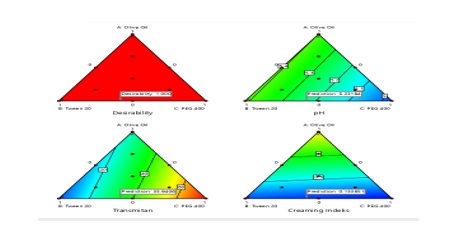
Dayak onion (Eleutherine bulbosa (Mill.) Urb) is known for its antioxidant, anti-inflammatory, and antimicrobial activities, attributed to its flavonoid, alkaloid, and saponin contents. However, the bioavailability of these active compounds is limited due to poor stability and absorption. To enhance their effectiveness, nanoemulsion formulations were developed. This study aimed to investigate the effects of varying concentrations of olive oil, Tween 20, and PEG 400 on the physical characteristics of nanoemulsions containing the water fraction of Dayak onion bulb extract, and the optimization was performed using a D optimal mixture design (Design Expert 13) with three independent variables: olive oil (1–11%), Tween 20 (1–11%), and PEG 400 (1–16%). The extract concentration was kept constant at 1%. The responses evaluated were pH, creaming index, transmittance, droplet size, polydispersity index, and zeta potential. The optimum formula was selected based on the highest desirability value. The optimal formulation exhibited a stable pH (5.00–6.12), a low creaming index (0–0.3), an average particle size of 308 nm with a polydispersity index of 0.51, and a zeta potential of –38.6 mV, indicating good electrostatic stability. However, the transmittance percentage did not reach the ideal standard (>80%). Significant differences were observed between predicted and experimental values for the creaming index and transmittance, and changes in the creaming index occurred during 30 days of storage. Further optimization is recommended to enhance the stability and clarity of the nanoemulsion.
Downloads
Syamsul ES, Supomo, Warnida H. Potensi Ekstrak Bawang Dayak Eleutherine bulbosa (mill.) Urb sebagai Obat Antikanker Payudara. RV Pustaka Horizon. 2024.
Gul U, Khan MI, Madni A, Sohail MF, Rehman M, Rasul A, et al. Olive oil and clove oil-based nanoemulsion for topical delivery of terbinafine hydrochloride: in vitro and ex vivo evaluation. Drug Delivery. 2022; 29(1). 600–612. https://doi.org/10.1080/10717544.2022.20398059.
Kampa J, Frazier R, Rodriguez-Garcia J. Physical and Chemical Characterisation of Conventional and Nano/Emulsions: Influence of Vegetable Oils from Different Origins, Foods. 2022;11(5). https://doi.org/10.3390/foods11050681
Budiarto W, Rochmah NN, Setiyabudi L. Formulasi Sediaan Nanoemulsi Ekstrak Daun Mangrove (Avicennia Marina) Dengan Virgin Coconut Oil Sebagai Fase Minyak. Jurnal Ilmiah JOPHUS : Journal Of Pharmacy UMUS. 2021; 2(01). 36–43. https://doi.org/10.46772/jophus.v2i01.272
Mathew R, Varkey J. Formulation and in vitro evaluation of self Nano emulsifying drug delivery system of quercetin for enhancement of oral bioavailability. Int J Curr Pharm Sci.2022;14(1):60-9. doi:10.22159/ijcpr.2022v14i1.44113.
Gan YL, Tan CP, Kqueen CY, Ariffin H, Wasoh H, Lai OM. Nanoemulsion and Topical Cream for Delivery of Tocotrienol-rich fraction, Ascorbyl Tetraisopalmitate, and Carotenes: Formulation and in vitro Release. Pertanika J. Trop. Agric. Sci. 2025;48(1): 91–116. http://www.pertanika.upm.edu.my/
Bian J, Gobalasingham N, Purchel A, Lin J. The Power of Field-Flow Fractionation in Characterization of Nanoparticles in Drug Delivery. Molecules. 2023;28(10): 4169. https://doi.org/10.3390/molecules28104169.
Lestari W, Setiyowati S, Triningsih T, Asyikin KF, Suharmadi S, Mujamilah M, et al. Optimasi Sintesa Nanokoloid Human Serum Albumin sebagai Agen Limfoskintigrafi Menggunakan Central Composite Design-Response Surface Methodology. Jurnal Kefarmasian Indonesia. 2022 12(1):69-78.
Datir RP, Ravindra MR, Manjunatha M, Sharma M. Optimization of recombination of milk at different fat levels in a small volume universal disperser unit. J Food Sci Technol. 2021;58(4): 1389–1400. https://doi.org/10.1007/s13197-020-04650-9.
Angelia, Putri GR, Shabrina A, Ekawati N. Formulasi Sediaan Spray Gel Ekstrak Kulit Jeruk Manis (Citrus sinensis L.) sebagai Anti-Aging. Generics: Journal of Research in Pharmacy. 2022;2(1): 42–52. e-ISSN: 2774-9967
Siqhny ZD, Azkia MN, Kunarto B. Karakteristik Nanoemulsi Ekstrak Buah Parijoto (Medinilla speciosa Blume). Jurnal Teknologi Pangan Dan Hasil Pertanian. 2020;15(1). 1. https://doi.org/10.26623/jtphp.v15i1.1888
Kampa J, Frazier R, Rodriguez-Garcia J. Physical and Chemical Characterisation of Conventional and Nano/Emulsions: Influence of Vegetable Oils from Different Origins, Foods. 2022;11(5). https://doi.org/10.3390/foods11050681
Putri RA, Syamsul ES, WarnidaH. Nanoemulsion Optimization of Dayak Onion (Eleutherine bulbosa (Mill) Urb.) Tuber Ethanol Extract Using Varying Concentration of VCO, Tween 80, and PEG 400. Jurnal Kefarmasian Indonesia. 2025;15(2):197-207.
Susilonadi AP, Azizah R, Wulandari A, Nesa NM, Putri YA, Suryanto E. Formulasi nanoemulsi ekstrak dan fraksi limbah pelepah aren (Arenga pinnata Merr.) sebagai agen antihiperlipidemia dan hipoglikemik untuk pencegahan penyakit degeneratif. Chem Prog. 2023;16(2):172–81. doi:10.35799/cp.16.2.2023.52295
Putri, Nurahmanto D, Agustian Rosyidi V. Optimasi Tween 80 dan Propilen Glikol Dalam Self-Nanoemulsifying Drug Delivery System (SNEDDS) Minyak Atsiri Daun Kemangi (Ocimum basilicum). Journal Pustaka Ilmu Kesehatan. 2021;9(2). 1–6.
Shabrina A, Khansa ISM. Physical stability of sea buckthorn oil nanoemulsion with tween 80 variation. Indonesian Journal of Pharmaceutical Science and Technology. 2022;1(1). 14-21.
Nirmalayanti NLPKV. Skrining Berbagai Jenis Surfaktan Dan Kosurfaktan Sebagai Dasar Pemilihan Formulasi Nanoemulsi. Metta : Jurnal Ilmu Multidisiplin. 2021; 1(3). 158–166. https://doi.org/10.37329/metta.v1i3.1552
Mahdiyyah AA, Farkhani A, Esadini AR, Pratama DP, Cahyadi SN, Rifkia V. Formulation, Characterization, and Total Phenolic Content of Moringa (Moringa oleifera L.) Leaf Extract Sunscreen Cream with Triethanolamine Base Comparison. Jurnal Kefarmasian Indonesia. 2025;15(2):222-232.
Sahumena MH, Suryani S. Formulasi Self Nano-Emulsifying Drug Delivery System (SNEDDS) Ibuprofen dengan VCO dan Kombinasi Surfaktan, Indonesian Journal of Pharmaceutical Education. 2023;2(3). 239–246. https://doi.org/10.37311/ijpe.v2i3.20405
Redhita LA, Beandrade MU, Putri IK, Anindita R. Formulasi Dan Evaluasi Nanoemulsi Ekstrak Daun Kemangi (Ocimum basilicum L.) Dengan Variasi Konsentrasi Tween 80. Jurnal Mitra Kesehatan. 2022;4(2). 80–91. https://doi.org/10.47522/jmk.v4i2.134
Zubaydah WOS, Indalifiany A, Yamin, Suryani, Munasari D, Sahumena MH, et al. Formulasi dan Karakterisasi Nanoemulsi Ekstrak Etanol Buah Wualae (Etlingera Elatior (Jack) R.M. Smith). Lansau: Jurnal Ilmu Kefarmasian. 2023; 1(1). 22–37. https://doi.org/10.33772/lansau.v1i1.4
Copyright (c) 2026 Jurnal Kefarmasian Indonesia

This work is licensed under a Creative Commons Attribution-NonCommercial-ShareAlike 4.0 International License.


