
Formulation, Characterization, and Total Phenolic Content of Moringa (Moringa oleifera L.) Leaf Extract Sunscreen Cream with Triethanolamine Base Comparison

Downloads
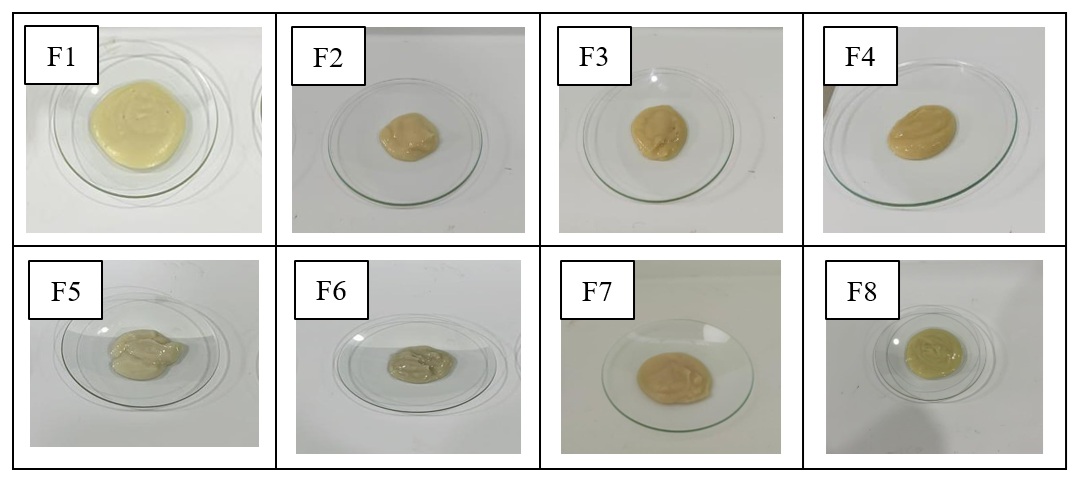
Moringa (Moringa oleifera L.) leaves contain secondary metabolites such as flavonoids, phenols, tannins, saponins, and alkaloids. The phenolic and flavonoid compounds show strong antioxidant activity that can neutralize free radicals and protect the skin from oxidative damage. Despite its known photoprotective potential, the use of Moringa leaf extract in stable sunscreen cream formulations is still limited. Moreover, the influence of extract and emulsifier (triethanolamine) concentrations on the cream’s physical properties and their relation to total phenolic content has not been well studied. This study aimed to develop and evaluate Moringa leaf extract-based sunscreen creams with extract concentrations of 1%, 1.5%, 2%, and 2.5%, and triethanolamine concentrations of 1% and 1.5%. Eight formulas were prepared and evaluated for organoleptic characteristics, spreadability, homogeneity, pH, viscosity, phase separation, and emulsion type. The total phenolic content was also determined using the Folin–Ciocalteu method. Results showed that increasing the concentration of extract and triethanolamine significantly affected the pH, spreadability, and viscosity of the cream (p < 0.05), while all remained within acceptable ranges for topical preparations. The total phenolic content increased proportionally with extract concentration, with Formula 8 (2.5% extract) showing the highest phenolic content of 25.12 mg GAE/g. These findings indicate that Moringa leaf extract has strong potential as a natural antioxidant and photoprotective agent for sunscreen cream formulations.
Downloads
Baldisserotto A, Barbari R, Tupini C, Buzzi R, Durini E, Lampronti I, et al. Multifunctional Profiling of Moringa oleifera Leaf Extracts for Topical Application: A Comparative Study of Different Collection Time. Antioxidants. 2023;12. https://doi.org/10.3390/antiox12020411.
Gopalakrishnan L, Doriya K, Kumar DS. Moringa oleifera: A review on nutritive importance and its medicinal application. Food Science and Human Wellness. 2016;5:49–56. https://doi.org/10.1016/j.fshw.2016.04.001.
Kessler JC, Martins IM, Manrique YA, Rodrigues AE, Barreiro MF, Dias MM. Advancements in conventional and supercritical CO2 extraction of Moringa oleifera bioactives for cosmetic applications: A review. The Journal of Supercritical Fluids. 2024:106388. https://doi.org/10.1016/J.SUPFLU.2024.106388.
Tshabalala T, Ndhlala AR, Ncube B, Abdelgadir HA, Van Staden J. Potential substitution of the root with the leaf in the use of Moringa oleifera for antimicrobial, antidiabetic and antioxidant properties. South African Journal of Botany. 2020;129:106–12. https://doi.org/10.1016/J.SAJB.2019.01.029.
Fachriyah E, Kusrini D, Haryanto IB, Wulandari SMB, Lestari WI, Sumariyah S. Phytochemical Test, Determination of Total Phenol, Total Flavonoids and Antioxidant Activity of Ethanol Extract of Moringa Leaves (Moringa oleifera Lam). Jurnal Kimia Sains Dan Aplikasi. 2020;23:290–4. https://doi.org/10.14710/jksa.23.8.290-294.
Sánchez-Suárez J, Villamil L, Coy-Barrera E, Díaz L. Photoprotection-related properties of a raw extract from Gordonia hongkongensis EUFUS-Z928: A culturable rare actinomycete associated with the Caribbean octocoral Eunicea fusca. Science Progress. 2024; 107. https://doi.org/10.1177/00368504241272454.
Stiefel C, Schwack W. Photoprotection in changing times - UV filter efficacy and safety, sensitization processes and regulatory aspects. International Journal of Cosmetic Science. 2015;37:2–30. https://doi.org/10.1111/ics.12165.
Chauhan L, Gupta S. Creams: A Review on Classification, Preparation Methods, Evaluation and its Applications. Journal of Drug Delivery and Therapeutics. 2020;10:281–9. https://doi.org/10.22270/jddt.v10i5-s.4430.
Romanhole RC, Fava ALM, Tundisi LL, Macedo LM de, Santos ÉM dos, Ataide JA, et al. Unplanned absorption of sunscreen ingredients: Impact of formulation and evaluation methods. International Journal of Pharmaceutics. 2020;591:120013. https://doi.org/10.1016/J.IJPHARM.2020.120013.
Fiume MM, Heldreth B, Bergfeld WF, Belsito D V., Hill RA, Klaassen CD, et al. Safety Assessment of Triethanolamine and Triethanolamine-Containing Ingredients as Used in Cosmetics. International Journal Toxicol. 2013;32:59S-83S. https://doi.org/10.1177/1091581813488804.
Lestari FA, Hajrin W, Hanifa NI. Optimasi Formula Krim Ekstrak Daun Katuk (Sauropus Androgynus) Variasi Konsentrasi Asam Stearat, Trietanolamin, dan Gliserin. Jurnal Kefarmasian Indonesia. 2020:110–9. https://doi.org/10.22435/jki.v10i2.2496.
Reka L, Godage CM, Wijayabandara J, Siriwardhene A. Evaluation of Antifungal Activity of Languas galangal Rhizome and Development of a Topical Antifungal Cream. Medicines. 2023;10:34. https://doi.org/10.3390/medicines10060034.
Shafi S, Shendarkar GR. Formulation And Characterization Of Polyherbal Topical Cream. International Journal of Advanced Scientific Research. 2021; 12 (1). http://www.sciensage.info
Akhlaghi SP, da Silveira Balestrin LB, Brinatti C, Pirolt F, Loh W, Glatter O. Preparation and Characterization of Stabilizer-Free Phytantriol-Based Water-in-Oil Internally Liquid Crystalline Emulsions. Journal of Pharmaceutical Sciences. 2020;1 09:2024–32. https://doi.org/10.1016/J.XPHS.2020.02.022.
Departemen Kesehatan Republik Indonesia. Farmakope Herbal Indonesia. II. Kementrian Kesehatan Republik Indonesia; 2022.
Baldisserotto A, Buso P, Radice M, Dissette V, Lampronti I, Gambari R, et al. Moringa oleifera leaf extracts as multifunctional ingredients for “natural and organic” sunscreens and photoprotective preparations. Molecules. 2018;23. https://doi.org/10.3390/molecules23030664.
Lukić M, Pantelić I, Savić SD. Towards optimal ph of the skin and topical formulations: From the current state of the art to tailored products. Cosmetics. 2021;8. https://doi.org/10.3390/cosmetics8030069.
Rohmani S, Desi BA, Wardhani WD. Potassium-Azeloyl-Diglycinate BB-Cream formulation with Triethanolamine variation, and its effects on In-Vitro SPF stability and values. Journal of Advanced Pharmacy Education and Research. 2022;12. https://doi.org/10.51847/MUHP4PTOLD.
Okafo SE, Anie CO, Alalor CA, Nwankwo LU. Evaluation of physicochemical and antimicrobial properties of creams formulated using Pterocarpus santalinoides seeds methanol extract. Journal of Applied Pharmaceutical Science. 2023;13:126–35. https://doi.org/10.7324/JAPS.2023.19934.
Yuliani NN, Siswandono, Erawati T, Elisma, Sambara J, Kapitan LAV, et al. Antioxidant and SPF Activity of Sunscreen Cream Preparations from 96% Ethanol Extract of Bractea Bougainvillea spectabilis Willd. International Journal of Advancement in Life Sciences Research. 2024;7:117–28. https://doi.org/10.31632/ijalsr.2024.v07i04.011.
Arbie S, Sugihartini N, Wahyuningsih I. Formulasi Krim M/A Dengan Variasi Konsentrasi Ekstrak Buah Pepaya (Carica Papaya L.) Menggunakan Emulgator Asam Stearat Dan Trietanolamin. Media Farmasi. 2021;16:97. https://doi.org/10.32382/mf.v16i1.1420.
Maha HL, Sinaga KR, Masfria. Formulation and evaluation of miconazole nitrate nanoemulsion and cream. Asian Journal of Pharmaceutical and Clinical Research. 2018;11:319–21. https://doi.org/10.22159/ajpcr.2018.v11i3.22056.
Agusriani, Diyah H, Azizah L, Fitrianingsih. Effectiveness of an Organic Mask of Moringa Leaves (Moringa oleifera) and Turmeric (Curcuma longa) for Facial Care. Jurnal Kefarmasian Indonesia. 2024;14:137–46. https://doi.org/10.22435/jki.v14i2.6640.
Ramadhan NU, Qonitah F, Ariastuti R. Uji Kandungan Fenolik Total Ekstrak Etanol Daun dan Kulit Batang Kelor (Moringa Oleifera). Jurnal Farmasi, Kesehatan dan Sains (FASKES). 2024;2.
Tran TPA, Tran TTV, Pham TL, Phan TKV. Potential use of Polyphenol-Enriched Extract from Moringa oleifera Leaves as an Active Ingredient in Sunscreen. Natural and Life Sciences Communications. 2024;23. https://doi.org/10.12982/NLSC.2024.016.
Damayanti WA, Cahyani ED, Nurchayani D. Uji mutu fisik dan analisis nilai Sun Protection Factor (SPF) krim tabir surya ekstrak daun kelor (Moringa oleifera L.). Jurnal Farmasi Sains dan Terapan. 2024;11(2). https://doi.org/10.33508/jfst.v11i2.5007.
Copyright (c) 2025 Jurnal Kefarmasian Indonesia

This work is licensed under a Creative Commons Attribution-NonCommercial-ShareAlike 4.0 International License.


