
Analysis of Characteristics, Fatty Acid Composition, Antioxidant Activity, and Beta-sitosterol of Moringa (Moringa oleifera Lam) Oil from Three Different Regions in Indonesia

Downloads
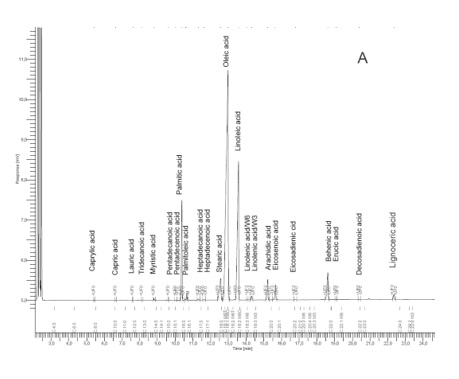
Moringa oil offers a range of health, nutritional, and cosmetic benefits. However, its characteristics can vary greatly depending on its geographical origin. This study aimed to compare the physicochemical properties, fatty acid composition, antioxidant activity, and beta-sitosterol content of moringa oil obtained from three regions in Indonesia: Central Java, Central Sulawesi, and East Nusa Tenggara. The physicochemical properties examined include organoleptic, specific gravity, viscosity, refractive index, iodine value, acid value, saponification value, and peroxide value. Furthermore, the fatty acid composition was analyzed using gas chromatography with flame ionization detection (GC-FID), antioxidant activity was evaluated by the 2,2-diphenyl-1-picrylhydrazyl (DPPH) method, and beta-sitosterol content was measured by thin-layer chromatography (TLC). Physical attributes, such as viscosity and specific gravity, do not exhibit significant differences between the regions. At the same time, chemical parameters, which include iodine value, acid value, and saponification value, show considerable variations. Fatty acid profiles revealed that oils from Central Sulawesi and East Nusa Tenggara have high oleic acid and low polyunsaturated fat content, providing better oxidative stability and longer shelf life. In contrast, Central Java oil showed higher levels of linoleic and behenic acids, making it more suitable for sensitive skin and hair care applications. Central Java oil exhibits the highest antioxidant activity, whereas Central Sulawesi oil contains the highest concentration of beta-sitosterol, suggesting a more significant potential as an anti-inflammatory agent. These findings highlight the influence of regional origin on the quality of moringa oil, presenting exciting opportunities for further research in this field.
Downloads
Echo P. Kementan berencana kembangkan pasar kelor hingga mancanegara. Fakultas Pertanian dan Peternakan Universitas Muhammadiyah Kotabumi. Published 2022. https://fpp.umko.ac.id/2022/02/11/kementan-berencana-kembangkan-pasar-kelor-hingga-mancanegara/
Hendrizal. Kelor NTT menembus dunia : Saatnya petani bangkit. sergap.co.id – BeritaSatu Network. Published 2025. Accessed April 30, 2025. https://www.beritasatu.com/network/sergap/533030/kelor-ntt-menembus-dunia-saatnya-petani-bangkit
Lawa Y. Uji minyak biji kelor (Moringa oleifera L.) organik asal NTT sebagai kandidat minyak goreng. In: Prosiding Seminar Nasional Pendidikan Dan Sains Kimia-2. Vol 2. ; 2018:60-64. https://www.researchgate.net/publication/342887538
Made Ngurah Budiana IG. Pembuatan biodiesel berbahan dasar minyak biji kelor asal kupang menggunakan katalis NaOH. Jurnal Beta Kimia. 2022;2(2):57-62. doi:10.35508/jbk.v2i2.9554
Salimi YK, Ischak NI, Ibrahim Y. Karakterisasi asam lemak hasil hidrolisis pada minyak biji kelor (Moringa oleifera) dengan metode kromatografi gas- spektroskopi massa. Jambura Journal of Chemistry. 2019;1(1):6-14. doi:10.34312/jambchem.v1i1.2101
Pareek A, Pant M, Gupta MM, et al. Moringa oleifera: An updated comprehensive review of its pharmacological activities, ethnomedicinal, phytopharmaceutical formulation, clinical, phytochemical, and toxicological aspects. International Journal of Molecular Sciences. 2023;24(3). doi:10.3390/ijms24032098
Leone A, Spada A, Battezzati A, Schiraldi A, Aristil J, Bertoli S. Moringa oleifera seeds and oil: Characteristics and uses for human health. International Journal of Molecular Sciences. 2016;17(12):1-14. doi:10.3390/ijms17122141
Cretella ABM, Soley B da S, Pawloski PL, et al. Expanding the anti-inflammatory potential of Moringa oleifera: topical effect of seed oil on skin inflammation and hyperproliferation. Journal of Ethnopharmacology. 2020;254:112708. doi:10.1016/j.jep.2020.112708
Shahbaz M, Naeem H, Batool M, et al. Antioxidant, anticancer, and anti-inflammatory potential of Moringa seed and Moringa seed oil: A comprehensive approach. Food Science and Nutrition. 2024;(July 2023):1-17. doi:10.1002/fsn3.4312
Liao PC, Lai MH, Hsu KP, et al. Identification of β-sitosterol as in vitro anti-inflammatory constituent in Moringa oleifera. Journal of Agricultural and Food Chemistry. 2018;66(41):10748-10759. doi:10.1021/acs.jafc.8b04555
Ayu LR, Aliwarga L, Studi P, Kimia T, Industri FT. Karakterisasi asam lemak dan aktivitas antioksidan minyak hasil ekstraksi biji kelor. Jurnal Teknik: Media Pengembangan dan Aplikasi Teknik. 2024;23(01):1412-8810. doi:10.55893/jt.vol23no1.568
Dising J, Pasau P. Karakteristik fisikokimia minyak biji kelor (Moringa oleivera L.). Partner. 2021;26(1):1491. doi:10.35726/jp.v26i1.479
Ermawati D, Cahyani PZ, Shahnaz I, Juniarty A, Mahardhika CL, Chasanah U. Formulation of serum using a combination of tamanu oil and tea tree oil as anti-acne. Jurnal Kefarmasian Indonesia. 2023;13(August):150-158. doi:10.22435/jki.v13i2.6570
Mitee T, Ekpette O. Determination of sprcific gravity and peroxide values of palm oil samples from gas flaring and non-gas flaring locations in Bayelsa State. Faculty of Natural and Applies Sciences Journal of Scientific Innovations. 2022;3(3):99-104. https://fnasjournals.com/index.php/FNAS-JSI/article/view/88
Fu X, Su J, Hou L, et al. Physicochemical and thermal characteristics of Moringa oleifera seed oil. Advanced Composites and Hybrid Materials. 2021;4(3):685-695. doi:10.1007/s42114-021-00302-4
Samanta A, Kataria N, Dobhal K, et al. Wijs, potassium iodate, and AOCS official method to determine the iodine value (IV) of fat and oil. Biomedical and Pharmacology Journal. 2023;16(2):1201-1210. doi:10.13005/bpj/2700
Badan Standarisasi Nasional. SNI 3741:2013 Minyak Goreng.; 2013. www.bsn.go.id
Nimal Ratnayake WM, Hansen SL, Kennedy MP. Evaluation of the CP-Sil 88 and SP-2560 GC columns used in the recently approved AOCS official method Ce 1h-05: Determination of cis-, trans-, saturated, monounsaturated, and polyunsaturated fatty acids in vegetable or non-ruminant animal oils and fats by. Journal of the American Oil Chemists’ Society. 2006;83(6):475-488. doi:10.1007/s11746-006-1230-y
Nugrahaeni F, Yati K, Sukmara S. The effect of variations of glyceryl monostearate on cream of super red dragon fruit (Hylocereus costaricensis Britt. Et R.) skin extract and antioxidant test. Jurnal Kefarmasian Indonesia. 2023;13(1):20-29. doi:10.22435/jki.v13i1.6099
Mallick SS, Dighe V V. Detection and estimation of alpha -Amyrin, beta -sitosterol, Lupeol, and n -triacontane in two medicinal plants by high performance thin layer chromatography. Advances in Chemistry. 2014;2014:1-7. doi:10.1155/2014/143948
Barakat H, Ghazal GA. Physicochemical properties of Moringa oleifers seeds and their edible oil cultivated at different regions in Egypt. Food and Nutrition Sciences. 2016;07(06):472-484. doi:10.4236/fns.2016.76049
Cueto Covarrubias LA, Valdez Solana MA, Avitia Domínguez C, Téllez Valencia A, Meza Velázquez JA, Sierra Campos E. Characterization of Moringa oleifera seed oil for the development of a biopackage applied to maintain the quality of Turkey ham. Polymers. 2024;16(1). doi:10.3390/polym16010132
Codex Alimentarius Commission. Codex General Standard for Edible Fats and Oils Not Covered by Individual Standards.; 1999. https://www.fao.org/4/y2774e/y2774e03.htm#bm3.1
He D, Liu L. Chapter 7 - Analytical aspects of rice bran oil. In: Cheong LZ, Xu XBTRB and RBO, eds. Rice Bran and Rice Bran Oil. AOCS Press; 2019:169-181. doi:10.1016/B978-0-12-812828-2.00007-X
International Organization for Standardization. ISO 3961:2024 Animal and Vegetable Fats and Oils — Determination of Iodine Value.; 2024. https://www.iso.org/standard/89081.html
Clarke L. Health benefits of incorporating unsaturated fats in diet. African Journal of Food Science and Technology. 2023;14(7):1-2. doi:10.14303//ajfst.2023.035
Okparanta S. Assessment of rancidity and other physicochemical properties of edible oils (mustard and corn oils) stored at room temperature. Journal of Food and Nutrition Sciences. 2018;6(3):70. doi:10.11648/j.jfns.20180603.11
Gupta MK. Chapter 2 - Basic Oil Chemistry. In: Gupta MKBTPG to VOP (Second E, ed. Practical Guide to Vegetable Oil Processing (Second Edition). AOCS Press; 2017:7-25. doi:10.1016/B978-1-63067-050-4.00002-7
Gharsallah K, Rezig L, Msaada K, Chalh A, Soltani T. Chemical composition and profile characterization of Moringa oleifera seed oil. South African Journal of Botany. 2021;137:475-482. doi:https://doi.org/10.1016/j.sajb.2020.11.014
International Organization for Standardization. ISO 660:2020 Animal and Vegetable Fats and Oils — Determination of Acid Value and Acidity.; 2020. https://www.iso.org/obp/ui/en/#iso:std:iso:660:ed-4:v1:en
Ogunsina BS, Indira TN, Bhatnagar AS, Radha C, Debnath S, Gopala Krishna AG. Quality characteristics and stability of Moringa oleifera seed oil of Indian origin. Journal of Food Science and Technology. 2014;51(3):503-510. doi:10.1007/s13197-011-0519-5
Ivanova M, Hanganu A, Dumitriu R, et al. Saponification value of fats and oils as determined from 1H-NMR data: The case of dairy fats. Foods. 2022;11(10):1-13. doi:10.3390/foods11101466
Cervera-Chiner L, Pageo S, Juan-Borrás M, García-Mares FJ, Castelló ML, Ortolá MD. Fatty acid profile and physicochemical properties of Moringa oleifera seed oil extracted at different temperatures. Foods. 2024;13(17):2733. doi:10.3390/foods13172733
de Almeida DT, Viana TV, Costa MM, Silva C de S, Feitosa S. Effects of different storage conditions on the oxidative stability of crude and refined palm oil, olein and stearin (Elaeis guineensis). Food Science and Technology (Brazil). 2019;39:211-217. doi:10.1590/fst.43317
Tüfekci F, Karataş Ş. Determination of geographical origin Turkish hazelnuts according to fatty acid composition. Food Science and Nutrition. 2018;6(3):557-562. doi:10.1002/fsn3.595
Elgadi S, Ouhammou A, Taous F, et al. Combination of stable isotopes and fatty acid composition for geographical origin discrimination of one argan oil vintage. Foods. 2021;10(6):1-13. doi:10.3390/foods10061274
Athikomkulchai S, Tunit P, Tadtong S, Jantrawut P, Sommano SR, Chittasupho C. Moringa oleifera seed oil formulation physical stability and chemical constituents for enhancing skin hydration and antioxidant activity. Cosmetics. 2021;8(1):1-18. doi:10.3390/cosmetics8010002
Pegoraro NS, Camponogara C, Gehrcke M, et al. Oleic acid-containing semisolid dosage forms exhibit in vivo anti-inflammatory effect via glucocorticoid receptor in a UVB radiation-induced skin inflammation model. Inflammopharmacology. 2020;28(3):773-786. doi:10.1007/s10787-019-00675-5
Öz M, Ucak İ, Nayik GA. Chapter 10 - PUFA and MUFA. In: Kour J, Nayik GABTN and HC, eds. Nutraceuticals and Health Care. Academic Press; 2022:199-215. doi:10.1016/B978-0-323-89779-2.00004-1
Zouboulis CC, Hossini AM, Hou X, Wang C, Weylandt KH, Pietzner A. Effects of Moringa oleifera seed oil on cultured Human Sebocytes in vitro and comparison with other oil types. International Journal of Molecular Sciences. 2023;24(12). doi:10.3390/ijms241210332
Korassa YB, Saptarini NM, Mustarichie R, Hendriani R. The potential of Moringa (Moringa oleifera Lamk) seed oil as anti-alopecia. Pharmacognosy Journal. 2022;14(2):379-387. doi:10.5530/pj.2022.14.49
Balić A, Vlašić D, Žužul K, Marinović B, Mokos ZB. Omega-3 versus Omega-6 polyunsaturated fatty acids in the prevention and treatment of inflammatory skin diseases. International Journal of Molecular Sciences. 2020;21(3). doi:10.3390/ijms21030741
Chen X, Li Z, Smith SA, et al. Optimization of supercritical CO2 extraction of Moringa oleifera seed oil using response surface methodological approach and its antioxidant activity. Frontiers in Nutrition. 2022;8(January):1-10. doi:10.3389/fnut.2021.829146
Hassan MHU, Shahbaz M, Ahmad S, et al. Assessment of Moringa Seed Oil: Fatty Acid Profile, Oxidative Stability and Antioxidant Activity: Assessment of Moringa Seed Oil. DIET FACTOR (Journal of Nutritional and Food Sciences). 2024;5(2):36-45. doi:10.54393/df.v5i2.139
Olszowy-Tomczyk M. How to express the antioxidant properties of substances properly? Chemical Papers. 2021;75(12):6157-6167. doi:10.1007/s11696-021-01799-1
Saeidnia S. The Story of Beta-sitosterol- A Review. European Journal of Medicinal Plants. 2014;4(5):590-609. doi:10.9734/ejmp/2014/7764
Copyright (c) 2025 Jurnal Kefarmasian Indonesia

This work is licensed under a Creative Commons Attribution-NonCommercial-ShareAlike 4.0 International License.


